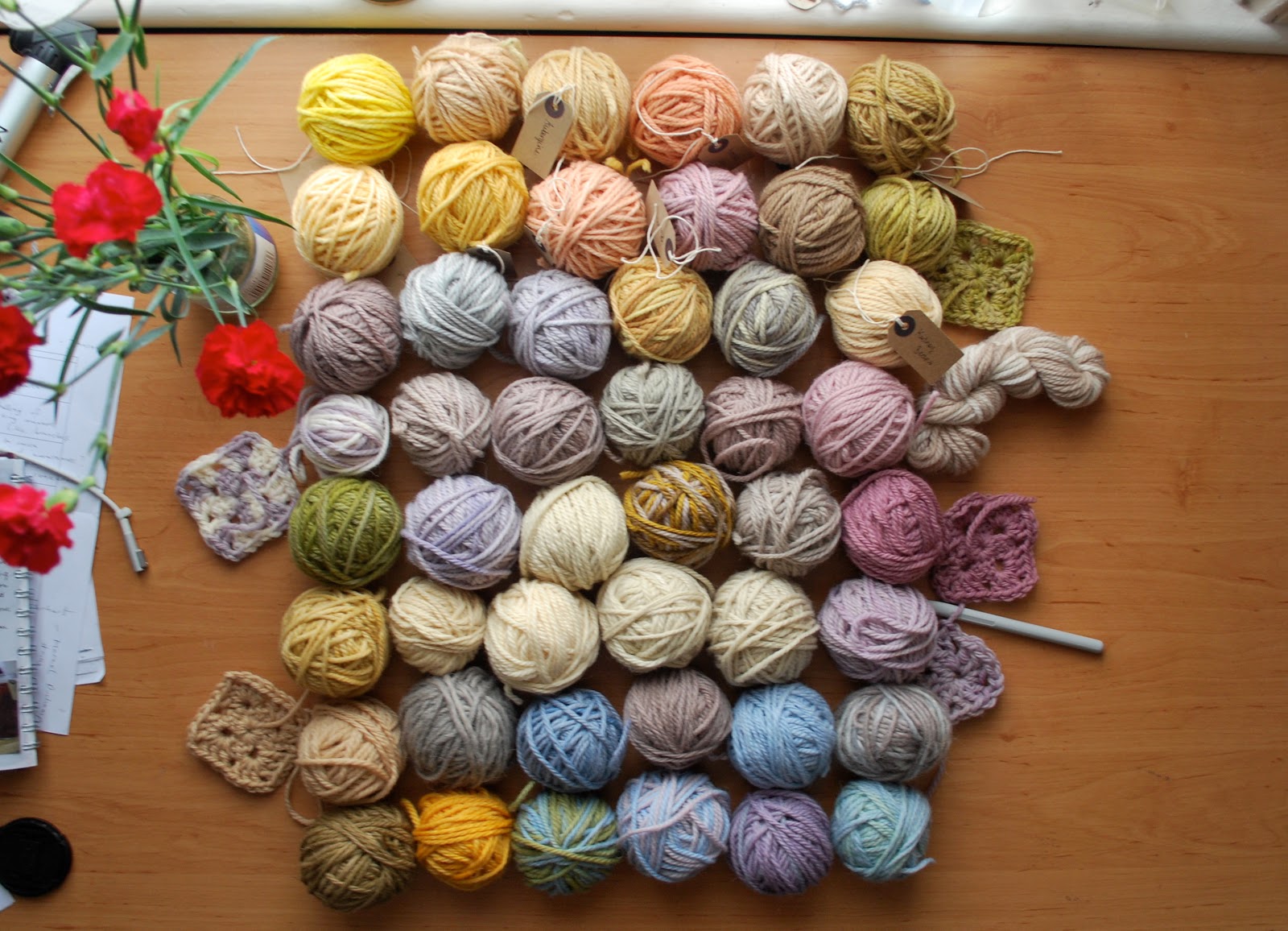
Showing posts with label dyeing. Show all posts

Sunday, 5 May 2013

The WildArt Trail

You may of may not know that I'm at university studying Fine Art. This term one of our units comprised of sharing our work in the 'public realm' and documenting it.
My friend Robin and I, chose to exhibit some of our work at the WildArt Trail which is in a nearby woodland (I say nearby, it was pretty much inaccessible without a car!) I wasn't hugely pleased with the outcome, but thought I'd share some photos anyway because the woods themselves are beautiful.


Here's my preparation for the exhibition:

I made thirty crocheted leaves, some I made from wool I'd dyed beforehand, and some I dyed after I'd made them. The colours were pretty vibrant and really stood out in the woods when I first put them up (though I'm not sure the photos show it well); the weather was still pretty gloomy and miserable so the trees had no leaves and there was barely any colour.


This is one of the pieces Robin installed. There were about 8 of these photo collages, head over to her site to see more of these and some of her other work. 

Here's what it looked like after 12 days, including 2 days of heavy rain and 8 or 9 of bright sunlight:


I like the fact that a couple of leaves had been torn off, I think it must have been birds taking them for their nests, which is just lovely. 

And a close-up of the ant enjoying one of the leaves.

- Kate


Wednesday, 24 April 2013

Unrepeatable Purple


I am SO pleased with this purple! So lovely :) It's made, unfortunately, with an unrepeatable technique...using a random amount of mixed berries from a 'black forest fruits' pack from Morrisons (a UK supermarket). I think it was a combination of blackberries, raspberries, blackcurrants and possibly morello cherries. The dye was quite concentrated and I soaked it for about 96 hours (it was stuck at uni and I couldn't get to it, so I was forced to be patient). It had sun on it for maybe a quarter of those hours and I think that probably intensified the colour. It's so pretty, I wish I'd made more! 


- Kate

Wednesday, 10 April 2013

Beetroot Adventures

For my birthday, my friend Holly bought me some lovely springform cake tins, one of which is the shape of a heart, so I decided to make a cake. When I came to making icing, I realised I didn't have any food colouring, and since I'd made the simplest, most basic cake on Earth, I really wanted it to be a bit more interesting!

I had a bit of a search through the cupboards and the fridge, and found some beetroot at the back of the fridge. I hate beetroot (for a vegetarian I'm not a massive fan of most vegetables unfortunately), but I had bought it to dye wool with. You may have seen what happened the last time I tried to dye wool with beetroot, but here's a photo:


I've grown to like it, but it wasn't quite what I was after! 

Anyway, back to food colouring. I didn't have any, and I wanted some! So I used the juice from the packet (I didn't want to use too much in case I ended up with beetroot-flavoured icing) to make baby pink icing. Here's the result:

So if you'd like to avoid food colouring for whatever reason, here's the recipe I used/made up:

Ingredients
175g of icing sugar
70g of softened butter
2 tsp vanilla essence
1 tsp lemon juice
A splash of milk
3 tbsp beetroot juice

Basically it's buttercream icing with a couple of extras. I used the vanilla essence and lemon juice to make sure there was no beetroot flavour and it seems to have worked quite nicely. Now I want to try other colours! I bet turmeric would make a crazy bright yellow. Maybe spinach might be worth a try too.


Then, remembering the failed wool dyeing, I decided to try cold-dyeing some wool in beetroot juice. I mushed up 3 beetroots (I bought the pre-cooked ones) and strained out the bits. Then I poured in a random amount of white vinegar (about the same amount of liquid I already had) and put a 100g skein of unmordanted wool in. 

I don't have any pre-mordanted wool at the moment because I haven't got round to it, so that's why I added the white vinegar to the dye instead. I don't know if it made any difference, but after just 2 hours I ran the skein under the tap and no dye came out! Here's the wet wool after I rinsed it. It will probably be a bit lighter once dry, but the colour looks great!


That white patch is kind of infuriating though...

- Kate

Vegetable Dyes Mordanted with Alum


Onion peel is great fun. You do not need 100g per 100g of yarn though! Even the peel from 1 or 2 onions will give quite a deep colour. As you can see, red onions give a browner colour, whereas normal onions give a more golden colour. 

I have also tried cold dyeing with onion peel (below).

This definitely needs an attempt 2! I think a deeper colour (possibly more yellow than green) might be the result of a cold dyebath.


Compared to the amazing colour of the dyebath, these colours were quite disappointing! The dye looks amazing, it's a vibrant purple/blue colour, but just doesn't seem to stick to the yarn very well. 


Does this count as a vegetable? I'm not sure but it had to go somewhere! My boyfriend bought me a bunch of roses (aw) and I didn't want to throw them away when they died so I made a dye. Each dyebath used the heads of 6 roses. I won't bother with a hot dyebath again, because the colour is so similar to the brown from red onion peel, but the colour from the cold dyebath is quite a sweet lavender purple so if I'm lucky enough to get more roses (hint hint) I may do it again.


Thanks for reading!
- Kate


Tuesday, 2 April 2013

Fruit Dyes Mordanted with Alum

Here are some photos from my dye book showing the fruit dyes I have made:

Skin of one passion cut off and simmered for 1 hour, then 25g of wool simmered for one hour. This is a beautiful soft green and I can't wait to try it again. This is NOT from an orange passion fruit, just the usual purpley coloured ones.

]
These blackcurrants were from my pack of frozen 'black forest fruits', I used as many as I could find and didn't weigh them but I suspect it was about 75-100g to just two 25g skeins of wool. I simmered these straight from frozen so had to use a potato masher to squish them in the pan. These were my first bright/deep colours and I love them. The second more purple colour uses the same dyebath, but after the first skein had taken most of the bright colour. I think it's quite interesting as you wouldn't have guessed they were from the same dye! Let me know if you are interested in variegated wool and I will make a photo tutorial :)

I used 50g of red grapes to dye these skeins. It doesn't show well in the photo but the dipped parts of the second skein are a lovely pale blue.

I used a different wool here and I think it is more susceptible to dye. Unfortunately it costs a lot more so I haven't done very many experiments with it!


I used four avocados for this, I think I got a bit carried away! Both skeins were only 25g. The second time I dyed using the avocado pits (below) the colour was completely different, so I think I might have burnt the dye! I would advise cold dyeing with avocado, it seems to be a bit more reliable.


Love this one! The writing says: 
"1 - Simmered with turmeric for 10 minutes (a), then simmered in blackcurrant for 1 hour.
2 - Turmeric and blackcurrant in same dye bath, simmered for 1 hour."


Thanks for reading!


Friday, 29 March 2013

Dyes I Have Made With Salt or Vinegar Mordants

I prefer alum as a mordant as it has given me more consistently 'exciting' results. By exciting I mean that the wool has taken the dye well and the colours tend to be deep shades of whichever colour.Salt and vinegar still have their place though, since they can both be bought easily at the supermarket, and there are still nice colours to be had.

Here are some of my results:


I thought that I had done something wrong with this one, but according to various places on the internet, beetroot just doesn't dye wool pink like you would think it does!

The second, brighter colour is wool mordanted with alum. I think with turmeric it doesn't make too much difference which mordant (if any) is used as it stains so easily.


There is a slight tint to this one, but nothing special. When I first dyed it it looked more orangey because the little bits of pepper were stuck to the yarn. I wouldn't have bothered with it at all but my housemates were convinced it would work! 


Here are the salt mordanted dyes:


The salt mordanted skein is actually a rather beautiful grey but I can't seem to capture it in a photograph...


As you can see, these colours are quite dull and similar to each other. I'm sure more exciting results can be achieved but I got my alum delivered and have used that for everything ever since!

-Kate


Dyestuffs I Have Used

Cassava
Black Forest Fruits (frozen cherries, blackcurrants and blackberries from the supermarket)
Blueberries
Strawberries
Raspberries
Beetroot (sorry, it doesn't make pink)
Turmeric
Cayenne pepper (doesn't work, don't bother)
Spinach
Red grapes (better as a cold dye)
Blackcurrants
Carrots (disappointing)
Passion fruit
Cherries
Red onion peel
Butternut squash (not much going on there)
Grass (once again, not much)
Blackberries
Yellow onion peel
Turmeric & blackcurrant mixed
Avocado (pits and skins)
Red cabbage
Rose petals (better as a cold dye)
Black beans (also known as black turtle beans)
Plum
Mushroom
Aubergine
Annatto seeds
Madder root

Thursday, 28 March 2013

How to Dye Yarn with Natural Dyes

When I first looked into natural dyeing it seemed so complicated and I didn't think I'd ever be able to do it. Once I'd figured it all out, I realised it's actually quite simple, so I decided to write a tutorial for anyone else who thinks the whole thing looks very exciting but a bit too complicated. I've never written a tutorial before so please comment or send me a message on my tumblr if something doesn't make sense.


There are 4 main steps:
a) Scour wool
b) Mordant wool
c) Make dye
d) Dye wool

And there are a few more than 4 ingredients:
Yarn - must be 100% or a high percentage NATURAL fibres. This includes wool, bamboo, merino etc.
A few old saucepans - most tutorials suggest a big pot like an old pressure cooker, but it depends how much wool you want to dye at a time. If the wool fits comfortably then it's fine. I say old saucepans because it's best not to eat out of them once they've been used for dyeing (I assume because of unknown chemical reactions, or if using garden plants that might be poisonous...but I don't really know!)
Washing-up liquid
Dye material - anything that you think might have colour in it. I will post a list of things I've used after this tutorial.
A mordant - alum (aluminium potassium sulphate if you want to find it on ebay!), vinegar or salt.
A sieve - should probably also be one you won't use for cooking.
Cream of tartar if using alum


a) Scouring

Essentially this just means to wash wool. It's easy to do, simply soak the skeins of wool in warm soapy water for 2 hours or longer. I use washing-up liquid because it's quite tough so should get rid of the natural oils or any treatments on the wool. Rinse in cold water afterwards. It's best not to go from cold to hot temperatures too quickly because the wool will start to felt.


b) Mordanting

There are a few different options here, but alum is the safest (no fumes) and most consistently satisfying that I've used. Other options are salt (for berries or fruit-based dyes), vinegar (for vegetable and other plant dyes), or iron sulphate (I've never used it but apparently it 'saddens' colours).

To mordant with alum, use 8g of alum and 7g of cream of tartar per 100g of wool (weighed dry). My scales are awful so my amounts are probably horribly off and it still works, so don't stress about making the weights super exact. Dissolve these in boiling water, then add more water to fill the pot. The website I used suggested a 10 litre pot for 100g of yarn but I forgot about that so ended up dyeing at least 400-500g in my 10 litre pot. It doesn't seem to have made any difference as long as the wool is saturated with water. Add the wool then bring the water to boil and simmer for an hour. If you simmer for longer than this it will start to smell like wet dog, so not a good idea. Either leave to cool and rinse in cold water, or rinse in hot water straight away. Once again, you don't want sudden temperature changes or the wool will start to felt.

To mordant with vinegar use 1 part white vinegar to 4 parts water, put the wool in and simmer for an hour, then rinse. This really smells so make sure you ventilate the room!

To mordant with salt use 1 part salt to 16 parts water, put the wool in and simmer for an hour, then rinse.

The main difference between using salt/vinegar and using alum, is that alum will give deeper and more contrasting colours, whereas salt and vinegar both give pastel colours. I use alum for all of my dyes and if I want a pastel colour I just use a more diluted dye.

c) Making dye

The general rule is 100g of dyestuff to 100g of wool. When you're experimenting that's probably a good place to start, and then once you've got an idea of how it works you can just make it up. NOTE, do not use 100g of onion peel! The peel from just 1 or 2 onions can dye a whole 100g of wool, you don't need very much at all.
Chop up your dyestuff, or mush it up a bit if it's berries and cover with water (about twice the amount of water to dyestuff). Bring to the boil and simmer for up to an hour.


Once it's reached an hour it's unlikely more colour will come out. With stuff like onion peel you only need to simmer for about 10 minutes. Strain the bits out using a sieve.
For beans or other dried things that you need to soak (black beans, for example), soak for 12 hours, drain (and save!), then soak for another 12 hours and use both lots of drained water for your dye.

d) Dyeing

Put the wool into the dye. If you want to be sure that it will dye evenly, wet the wool before putting it into the dye, or wear rubber gloves and squeeze it until it is saturated with dye.


Simmer for an hour. Don't let the dye boil because the agitation will almost certainly felt the wool.
You can also cold dye the wool. I do this using jars, and leave the wool to soak for 24 hours before rinsing it out. Some colours seem to work better with cold dyeing, and others better with hot, it's all about experimentation.
Rinse out the wool and hang it to dry. Wool holds a LOT of water so give it a gentle squeeze before hanging it out to dry or it will take days.


I have a few specific posts on tumblr showing how I used each dye material, so click here for those.

Enjoy!

-Kate


LinkWithin

Related Posts Plugin for WordPress, Blogger...